
The cost range, in one paragraph
Cornice repair on a typical four-story Brooklyn brownstone runs $8,000 to $50,000, with most projects landing in the $12,000–$25,000 range. Higher-end Manhattan landmark cornice work runs $25,000–$75,000+. The range is wide because "cornice repair" covers everything from a quick scrape-and-paint to a full rebuild with custom-fabricated decorative elements.
If you want one number to anchor on for a typical NYC brownstone: plan on $15,000 for a properly done cornice repair, plus or minus 50% based on condition and access. That number includes scaffolding, materials, and proper rust treatment. Budgets significantly below that are usually skipping something important.
What drives cost
Cornice cost is driven by five factors, in roughly this order of importance:
1. Extent of rust and metal failure. A cornice with surface rust only is a different project from one where the underlying steel has thinned through. The latter requires patching, soldering, or replacement of metal sections. This single variable can swing cost by 3x.
2. Decorative complexity. Plain cornices are cheaper than ornate ones. Cornices with brackets, dentil rows, scrollwork, and pediments require individual attention to each element. Bedford-Stuyvesant Romanesque buildings often have 2-3x more decorative detail than a simple Italianate cornice on Court Street.
3. Building height. A four-story building costs less to scaffold than a six-story building. A taller building means more material, more labor hours at height, and more scaffolding rental time.
4. Access. Some buildings have setback yards or available driveways for setup; some are flush to the sidewalk and require sidewalk-shed permits, more elaborate scaffolding, and more DOB coordination.
5. LPC requirements. Historic district work requires application preparation, approved materials, and documentation that adds 15–30% to the cost of equivalent non-LPC work.
Scope tiers, from cosmetic to full rebuild
Most cornice projects fall into one of four scope tiers. Understanding which tier you need is half the work of getting an honest quote.
Tier 1: Cosmetic refresh — $3,000–$9,000
Light scope. Scrape, prime, paint. Cosmetic only — no underlying repair work. Appropriate when the cornice has decent integrity but the paint is failing. Risky if there is any rust beyond surface level — the underlying problems will show through within 2–3 years.
Tier 2: Standard repair — $8,000–$25,000
The most common project. Scrape to sound substrate, treat the rust, patch where needed, prime, recoat with color match. Works for most NYC brownstone cornices that have been maintained but not seriously restored in 20+ years.
Tier 3: Major restoration — $20,000–$50,000
For cornices with significant rust, missing decorative elements, or substantial metal loss. Includes recreation of lost ornament, soldering, partial section replacement. Most "I should have done this 10 years ago" projects land here.
Tier 4: Full rebuild / Landmark — $25,000–$75,000+
For cornices that are too far gone for repair, or for landmark projects with full LPC review and approved-material constraints. Often involves custom fabrication of new cornice sections to match the original profile.
Scaffolding — the unavoidable line item
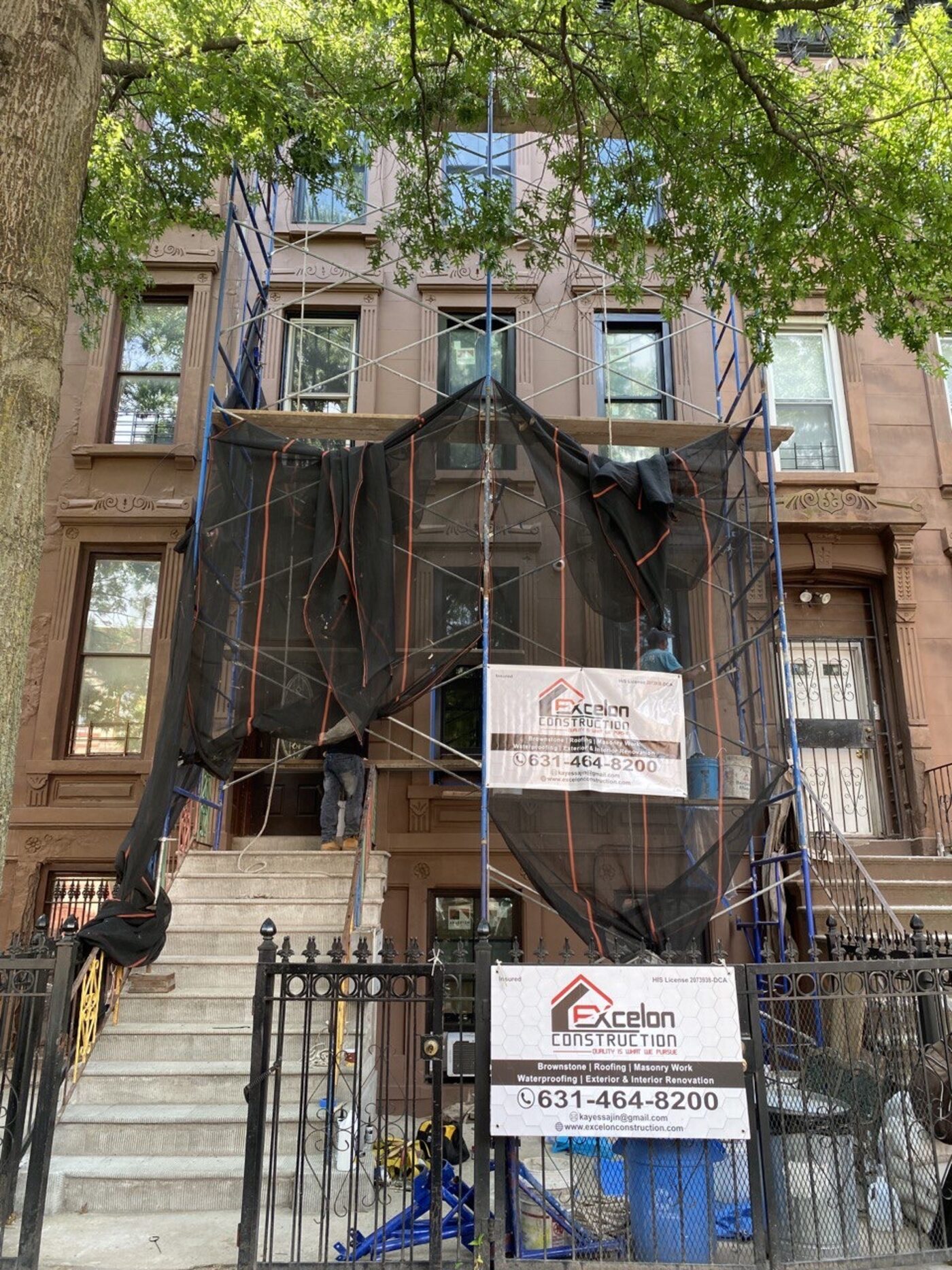
For any meaningful cornice work, you need to be at the cornice. There is no way around scaffolding or a sidewalk shed.
Scaffolding for a typical Brooklyn brownstone cornice job:
- Pipe scaffolding setup: $3,000–$8,000 (setup + teardown).
- Sidewalk shed (if required): $5,000–$10,000 setup plus $1,500–$3,000/month rental.
- DOB scaffold permit: $500–$1,500 in fees.
For most cornice projects, scaffolding accounts for 15–30% of the total project cost. This is unavoidable — the savings come from completing the work efficiently while the scaffolding is up. This is also why we recommend bundling related work (cornice + brownstone + stoop) under one scaffolding setup when multiple scopes are needed.
Why cheaper isn't always cheaper
Cornice work is one of the easier scopes to fake. Two contractors can quote the same building, one at $8,000 and one at $20,000, and from the sidewalk afterward both buildings can look fine — for about 18 months.
The $8,000 contractor likely:
- Did not strip back to sound substrate (just primed over failing surface).
- Skipped rust converter on the metal (just primed over rust).
- Used cheap interior-grade caulk on the seams.
- Used a one-coat masonry paint that chalks and fades in 2–3 years.
- Did the work in 2 days that should have taken 1–2 weeks.
The $20,000 contractor did the actual work properly — which means the $20,000 buys you 25+ years before the next major intervention. The $8,000 buys you 2–4 years.
The math: $20,000 every 25 years = $800/year. $8,000 every 4 years = $2,000/year. The "expensive" option is 60% cheaper over the building's lifetime.
Red flags in cornice estimates
If you are getting bids on cornice work, here is what to watch for:
1. No mention of rust treatment. A proper cornice estimate specifies what rust treatment will be used — typically a phosphoric-acid converter and a high-build epoxy primer. If the estimate just says "scrape and paint," that is a Tier 1 cosmetic job priced as if it were Tier 2.
2. No specific paint product or color-match approach. "We will use exterior masonry paint in a color similar to your facade" is not a spec. "Two coats of [specific product] tinted on-site to match the existing facade" is.
3. No discussion of seam caulking. Cornice failure starts at seams. A proper estimate addresses how seams will be sealed.
4. No scaffolding line item. If scaffolding is bundled into a single number with no breakout, you cannot tell whether the contractor is using proper pipe scaffolding or a single ladder. Ask.
5. Wildly low number. Anything dramatically below the typical range for your building is either skipping critical steps or the contractor will up-charge mid-project. Be skeptical.
Frequently asked questions
Can I just get my cornice painted instead of properly repaired?
You can — for about 18 months of cosmetic improvement before the underlying issues come back through. We do not do paint-only "cornice repairs" because they are not actually repairs. If you only need a paint refresh on a sound cornice, we will tell you that. If the cornice has any meaningful underlying issues, painting over them is throwing money away.
How long should cornice repair take?
A standalone cornice repair on a typical four-story Brooklyn brownstone takes 3–10 days of actual work, plus 1–3 days for scaffolding setup and 1 day for teardown. Total project duration is usually 2–3 weeks. Larger or landmark scopes can run 4–8 weeks.
Do I need permits for cornice repair?
Yes — at minimum, a DOB scaffold permit. For LPC-protected buildings, you also need LPC approval. The contractor handles permitting as part of the project.
How often should cornice work be done?
A properly executed cornice repair (Tier 2 or higher) lasts 25–35 years on a typical NYC brownstone. After that, the next cycle of intervention becomes due. With ongoing minor maintenance (touch-up painting, monitoring), you can sometimes stretch this to 40+ years.
Want a real cornice estimate?
Send us photos of your cornice from the sidewalk and we can usually tell you over the phone whether you are looking at Tier 1, 2, or 3 — and a rough cost range, before you ever schedule a visit. Call Sajin at 631-464-8200.
More from the journal.
Why Your Brownstone Is Spalling
The science of facade failure, and the right fix.
Brownstone Restoration Cost in NYC
What full restoration looks like at every scope tier.
Local Law 11 / FISP Guide
Cornice work that is FISP-driven runs different rules.