
What is Local Law 11 / FISP?
Local Law 11 — formally the Facade Inspection & Safety Program (FISP) — is New York City's mandatory facade inspection program for buildings six stories or taller. It was enacted after a 1979 fatal accident on the Upper West Side, in which a Barnard student was killed by falling masonry from an apartment building. The law requires periodic professional inspections of building facades to identify dangerous conditions before they fall on anyone.
FISP applies to every building in NYC that is more than six stories tall — full stop, regardless of building type, ownership, age, or use. Co-op, condo, rental, mixed-use, commercial, institutional. If it is taller than six stories, FISP applies.
The inspection has to be conducted by a Qualified Exterior Wall Inspector (QEWI), which is typically a licensed architect or engineer with the appropriate FISP credential. The inspector files a report with the NYC Department of Buildings classifying the facade in one of three categories — and the classification triggers everything that comes next.
Who has to comply
The simple rule: if your building is taller than six stories, you have to comply. There are no neighborhood exemptions, no historic-district exemptions, no small-building exemptions above the six-story threshold.
Compliance is the building owner's responsibility. For co-ops and condos, that means the board (or, in practice, the management company) is responsible for hiring the QEWI, paying for the inspection, executing any required repairs, and filing the appropriate documentation with DOB.
For rental buildings, the landlord is responsible. For commercial buildings, the owner. For mixed-use buildings, generally the building owner — though leases sometimes shift specific repair costs to commercial tenants.
If you bought a building and assumed your prior owner's FISP cycle was up to date — verify that immediately. Inheriting an out-of-cycle building means inheriting penalties.
The 5-year inspection cycle
FISP runs on a five-year cycle. Every covered building has an assigned inspection cycle window (Cycle 9, Cycle 10, etc.), and during that window, an inspection report has to be filed with DOB.
Buildings are assigned to one of three "sub-cycles" (A, B, or C) based on the last digit of their block number, which staggers inspections across the city so DOB is not flooded all at once.
Within each cycle window, the timeline runs roughly like this:
- Filing window opens — typically a 2-year period during which the inspection report has to be filed.
- Inspection performed — the QEWI does a physical inspection of the facade, usually from a scaffold or scissor lift, and for tall buildings often hands-on inspection at multiple elevations.
- Report filed with DOB — typically within 60 days of the inspection.
- Repairs (if required) — the building has up to 90 days from the report filing to complete any "Unsafe" repairs, with possible extensions.
- Subsequent reports filed — additional reports filed when repairs are complete, certifying the building back to "Safe."
Missing the filing window means immediate penalties — typically several thousand dollars per month, accumulating until the report is filed.
Safe, Safe With Repair, or Unsafe
The QEWI inspector classifies your building into one of three categories. The classification determines what happens next.
Safe (SWARMP — Safe With a Repair and Maintenance Program): The facade has no immediate safety issues. The building gets a "Safe" classification and is good for the next cycle. Most well-maintained buildings land here.
Safe With Repair: The facade has identified conditions that need repair within a specified timeframe (typically the next cycle). The building is technically safe right now, but maintenance is required before the next inspection. This is the most common classification for buildings that have not had recent serious facade work.
Unsafe: The facade has conditions that pose an immediate safety risk — loose masonry, failing cornice, structural concerns. This classification triggers immediate sidewalk shed installation at the owner's expense, plus mandatory repair within 90 days, plus a re-inspection to certify back to safe.
Going to "Unsafe" is the expensive scenario. The sidewalk shed alone runs thousands of dollars a month, the repairs are time-pressured, and DOB will not let you remove the shed until repairs are complete and certified.
What FISP compliance actually costs
The full cost of FISP compliance varies enormously by building. A small Brooklyn brownstone-coop that is six stories tall, in good condition, and gets a "Safe" classification might spend $5,000–$15,000 every five years on inspection and minor repairs.
A larger Manhattan apartment building that gets "Safe With Repair" and needs cornice work, repointing, and lintel repair might spend $80,000–$300,000 per cycle on the repair work itself, plus $10,000–$40,000 on the inspection, plus engineering and architect fees.
A building that lands "Unsafe" sees the highest costs: repair work is on a tight timeline (less negotiating leverage), sidewalk sheds add $5,000–$15,000 per month, and DOB violations and penalties stack up if anything slips.
Rough budgeting figures for typical NYC residential buildings:
- QEWI inspection alone: $5,000–$25,000 depending on building size and complexity.
- Typical "Safe With Repair" repair scope: $30,000–$200,000.
- Sidewalk shed (when required): $5,000–$15,000 per month.
- Final certification filings: $2,000–$5,000.
The repair process, step by step
If your QEWI report comes back "Safe With Repair" or "Unsafe," here is what the work typically looks like.
1. Engage the contractor
You hire a contractor experienced in FISP repair — ideally one who has worked with the QEWI on prior buildings. The contractor reviews the report, walks the building, and quotes the repair scope.
2. Permits and scaffolding
DOB permits are pulled. Scaffolding (or sidewalk shed if "Unsafe") is installed.
3. Repairs performed
The specific scope from the report is executed. Common items: cornice repair, brick repointing, lintel repair, parapet rebuilding, loose masonry remediation. Repairs are documented with progress photos.
4. QEWI re-inspection and re-certification
Once repairs are complete, the QEWI returns, inspects the work, and files an amended report certifying the building "Safe."
5. Sidewalk shed removal
For "Unsafe" projects, the shed comes down only after re-certification. This is the single biggest reason to move quickly on Unsafe repairs.
Common findings on Brooklyn & Manhattan buildings
Across hundreds of FISP-driven repair projects we have worked on, the same handful of issues come up repeatedly. If your building has any of these, expect them to show up in your QEWI report:
- Cornice rust, sagging, or loose elements. The single most common Unsafe finding. Cornice repair work is the bulk of NYC FISP repair.
- Failed mortar joints. Joints that have eroded or failed entirely allow water entry and create loose-brick risks. Repointing is almost always part of the scope.
- Cracked or displaced lintels. The horizontal stones or steel lintels above windows can crack, corrode, or shift. Repair is a standard scope.
- Parapet wall instability. The parapet (the wall above the roofline) gets the most weather exposure of any part of the building. Failures here are common and serious.
- Loose or hollow-sounding masonry. Brick or stone that has separated from its substrate is an immediate concern.
The most expensive mistakes owners make
FISP is not the place to save money on the wrong things. The most expensive mistakes we see, repeatedly:
1. Ignoring the filing deadline. Penalties accumulate by the month. A $15,000 inspection becomes $25,000+ if you miss the window long enough.
2. Hiring the cheapest contractor for repair work. FISP repair work is what is going to keep your building safe for the next 5+ years. Cutting corners on materials or installation means failure during the next cycle, plus interim repair costs, plus the embarrassment of an Unsafe re-classification.
3. Deferring "Safe With Repair" items. If the report says repairs are needed by next cycle, schedule them. Letting a "Safe With Repair" become an "Unsafe" five years later costs dramatically more.
4. Getting only one bid. FISP repair is highly variable in scope and price. Get three. Get them in writing. Compare apples to apples — what materials, what scope, what warranty.
5. Underestimating sidewalk shed costs. An "Unsafe" classification with a sidewalk shed for six months can cost more in shed rental than the actual repair work. Prioritize getting Unsafe items done fast above all else.
Frequently asked questions
Does FISP apply to my Brooklyn brownstone?
Only if it is more than six stories tall, which most Brooklyn brownstones are not. Standard four-story brownstones are exempt from FISP. They are still subject to standard DOB facade safety standards, but the formal five-year inspection cycle does not apply.
I bought a building with a "Safe With Repair" status. What does that mean for me?
You inherit the repair obligations and timeline. The clock does not reset on purchase. Get the prior FISP report, identify what repairs are required, and schedule them well before the next cycle window opens. Talking to the QEWI of record is often a good starting point.
Can I do FISP repairs myself or with an unlicensed contractor?
No. FISP repair work has to be performed by a properly licensed contractor and certified by a QEWI. Unlicensed work will not be accepted by DOB and will leave you in violation regardless of how good the work actually is.
How do I find out my building's FISP status?
Search the DOB BIS (Building Information System) for your building's address. The FISP filings are public record. Or call us — for a quick lookup, we can usually tell you the current status in 5 minutes.
Need help with FISP-driven repairs?
We have done hundreds of FISP repair projects across Brooklyn and Manhattan, including coordination with QEWIs and architects. If you have a recent report and need a contractor, we can quote the scope and execute on schedule. Call Sajin at 631-464-8200.
More from the journal.
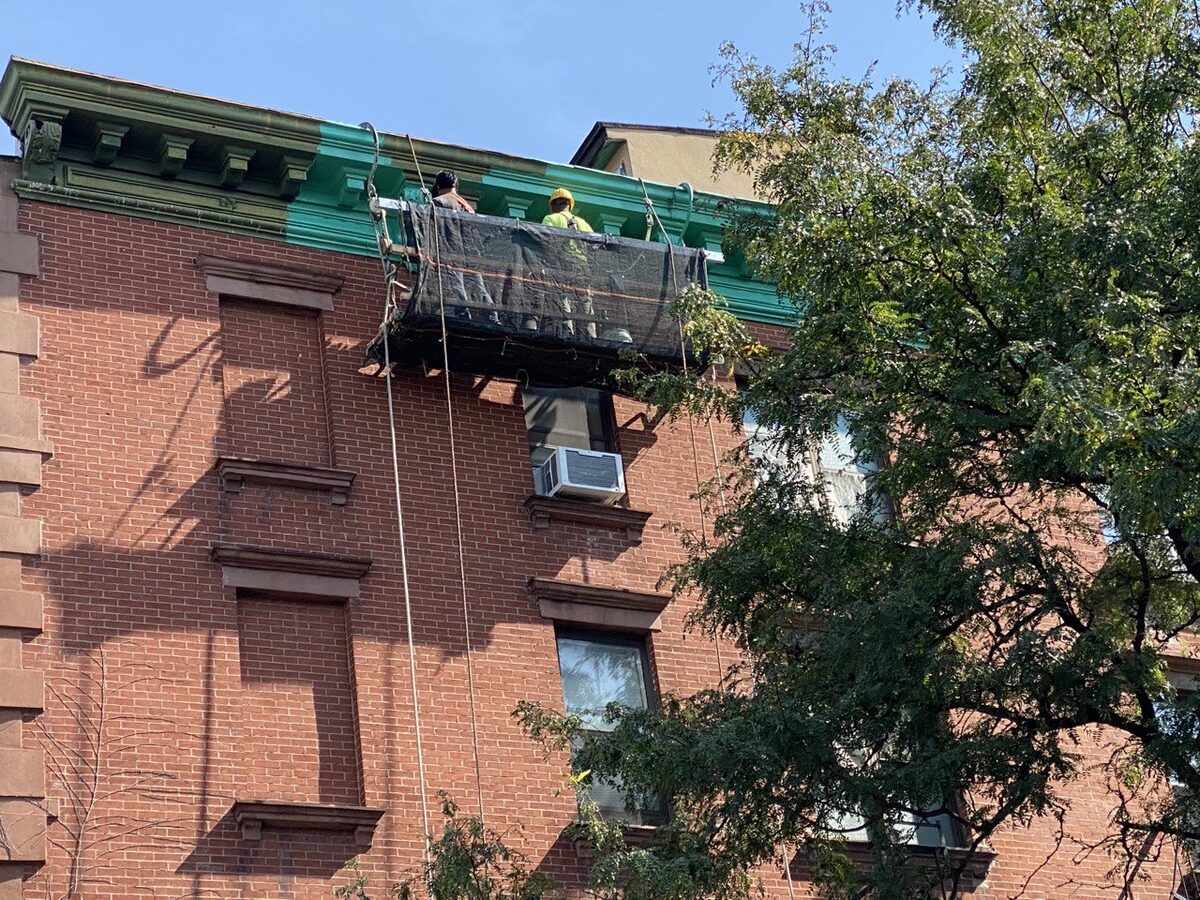
Cornice Repair Cost in NYC (2026)
What the work actually costs, by scope.
Why Your Brownstone Is Spalling
The science of facade failure, and the fix that lasts.
LPC Approval: A Step-by-Step Guide
Navigate the Landmarks Preservation Commission process.