
Fort Greene housing stock
Fort Greene developed in two main waves: an earlier wave of Italianate and Greek Revival row houses from the 1850s–70s, and a later wave of Romanesque Revival and Renaissance Revival brownstones from the 1880s–1900s. The result is unusually consistent housing stock — most blocks read as a coherent ensemble even though the individual buildings span 50 years of construction.
Many Fort Greene homes feature elaborate stoop work, decorative ironwork, and prominent cornices. The streets nearest Fort Greene Park (Cumberland, South Portland, South Oxford) hold some of the most architecturally significant buildings.
Common deterioration patterns in Fort Greene
Common Fort Greene facade issues:
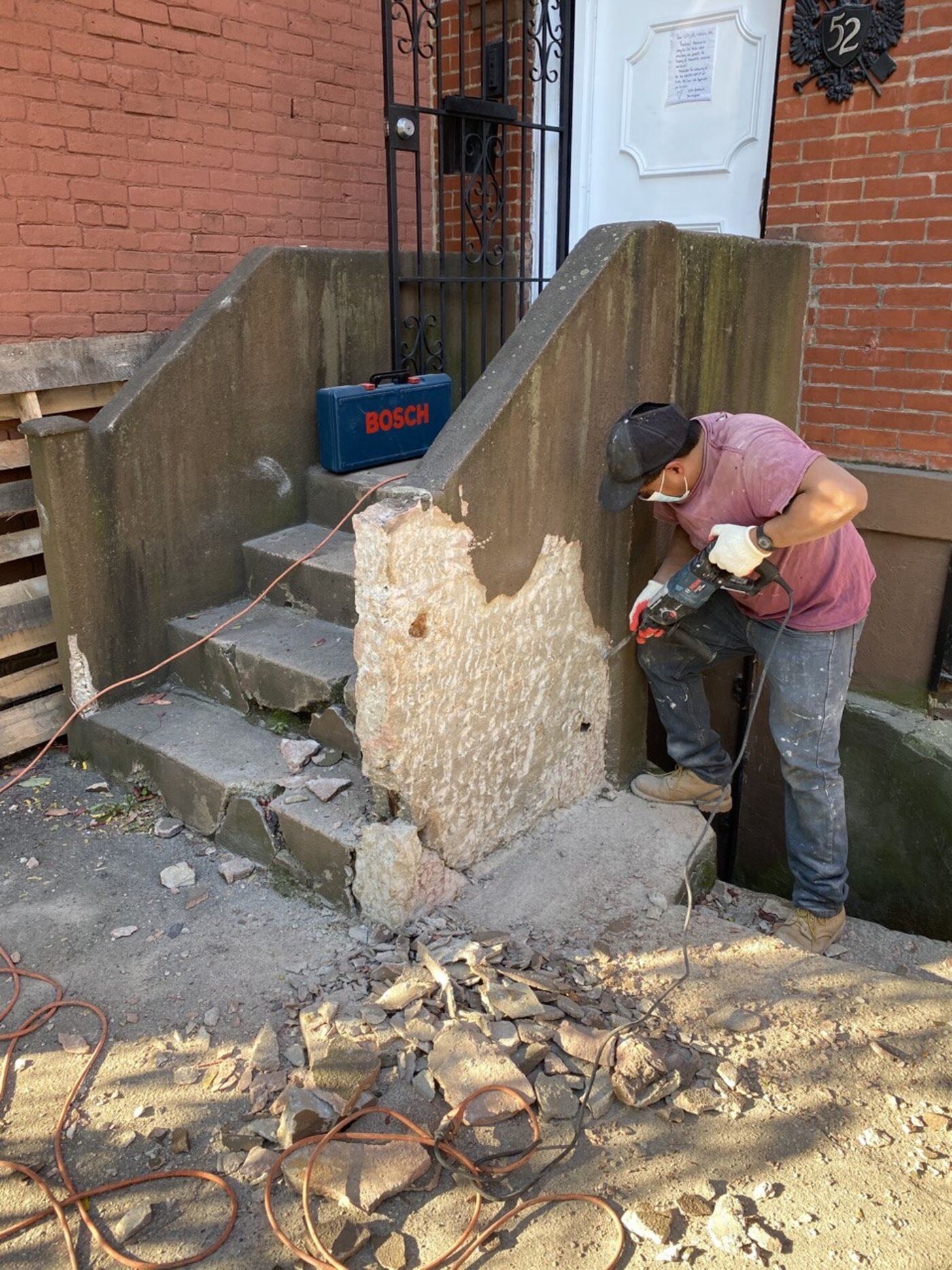
- Stoop deterioration from heavy daily use and tree-canopy moisture (Fort Greene's tree-lined streets keep stoops damp).
- Cornice rust on the elaborate sheet-metal cornices common in the late-1880s buildings.
- Brownstone spalling at lower facade where street salt accumulates.
- Wrought iron failures on the often-ornate stoop railings and yard fences.
Landmark & LPC status
The Fort Greene Historic District (designated 1978) covers the heart of the neighborhood, including most blocks within walking distance of Fort Greene Park. Almost any visible exterior work in the district requires LPC review.
We coordinate LPC applications and execute work to standards expected for one of Brooklyn's most architecturally protected residential neighborhoods.
Excelon projects in Fort Greene
Below are recent Excelon projects in Fort Greene. Each is a real address; we are happy to walk you to any of them in person.
How to start
The fastest way is a phone call to Sajin at 631-464-8200. We will set up a time to come to Fort Greene and look at your building. The walkaround is free, takes 30–60 minutes, and there is no obligation to move forward.
If you prefer to send photos and details first, use the contact form. We typically respond within one business day.