
What brownstone restoration actually is
Brownstone restoration is the careful, mostly handmade process of returning the exterior of a sandstone-clad row house to a sound, weather-tight, visually correct condition — without erasing the original mason's work that made the building beautiful in the first place. It is not painting. It is not stuccoing over the problem. It is not slapping a "stone-look" coating on a damaged facade and calling it done.
Done correctly, brownstone restoration involves stripping back to sound substrate, identifying and addressing the cause of deterioration, replacing or recarving lost stone, applying a vapor-permeable patching system that matches the original color and texture, and protecting the finished surface against water entry. Done correctly, it lasts twenty to thirty years before any meaningful intervention is needed again.
Done incorrectly — which most of it is, in our experience — it lasts five to seven years and costs the homeowner two or three times more in the long run. The wrong contractor, using the wrong materials, will almost always leave you with a facade that looks beautiful for two summers and starts failing in the third.
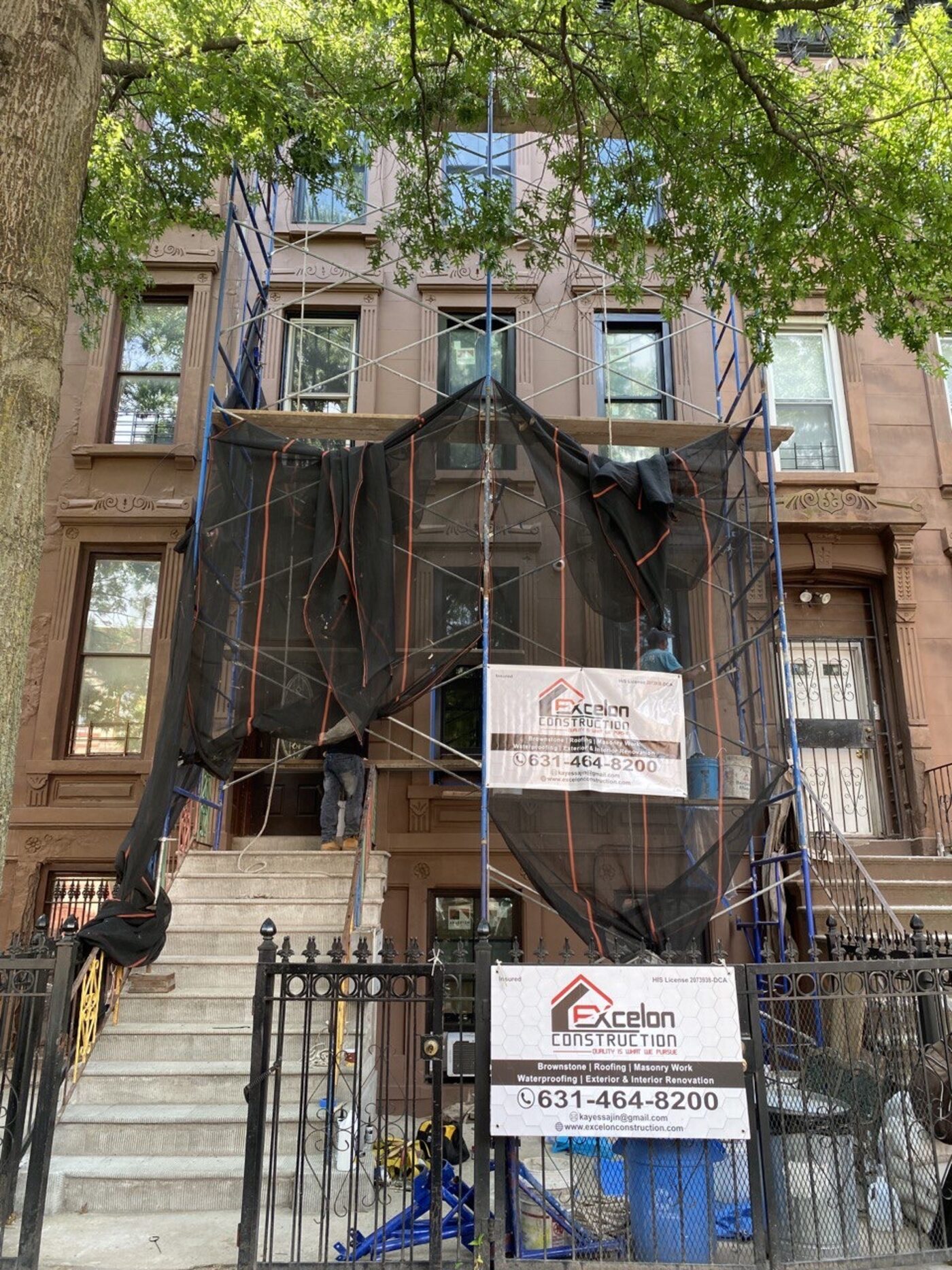
Why brownstones deteriorate in the first place
Most brownstone in New York is not actually brownstone in the geological sense — it is a layered sandstone, primarily quarried from Portland, Connecticut between roughly 1850 and 1900. Builders loved it because it was soft, easy to carve, available in massive quantities, and cheaper than limestone. The problem is that the same softness and porosity that made it cheap and carvable also makes it inherently vulnerable to water.
Here is what happens, in slow motion, to every untreated brownstone in NYC over the course of a hundred years:
- Water enters the stone through hairline cracks, failed mortar joints, or simply by capillary absorption when it rains.
- The water freezes inside the stone in winter. Ice is larger than water. The stone splits along its natural bedding planes — usually parallel to the surface.
- A layer lifts off. This is called spalling or delamination. It often takes a piece of carved ornament with it.
- More water gets in faster through the new crater. The cycle accelerates.
- Salt and pollution amplify everything. NYC's road salt, acid rain, and combustion byproducts all chemically attack the stone's binders.
By the time a homeowner notices the problem, the surface deterioration is usually decades old and several inches deep. The visible damage is always less than the actual damage. This is the single most important thing to understand about brownstone work, and the single thing that wishful thinking — and a lot of bad contractors — try to ignore.
The most expensive brownstone repair is the one you delay
A facade caught at the "minor spalling" stage typically costs 30–40% of what the same building costs ten years later, after multiple winters of accelerating damage. We tell every prospective client this on the first visit. It is not a sales tactic; it is the math.
Our brownstone restoration process, step by step
Every Excelon brownstone job follows the same eight-step rhythm. Some steps take an afternoon. Some take a week. None of them are skipped.
1. On-site assessment
Sajin walks the facade with you, top to bottom. We tap the stone to find delamination you cannot see. We look at the cornice, the lintels, the stoop, the basement entry. We check for the underlying cause — a failing roof above, a clogged drain, broken pointing — that the surface damage is the symptom of. The walkaround is free and takes 30 to 60 minutes.
2. Itemized written estimate
Within roughly a week you receive a line-by-line written estimate. We specify materials by manufacturer. We separate must-do from should-do from optional. We attach a realistic schedule. There is no obligation to move forward.
3. Permits, scaffolding, and protection
If your building is in an LPC historic district, we coordinate the permit application. We pull DOB sidewalk shed and scaffold permits where required. We protect the stoop, the ironwork, the front door, the windows, the planted area in front, and the neighbors' property — before any tools come out.
4. Strip back to sound substrate
This is the step every shortcut-taking contractor skips. We mechanically remove all delaminating, spalling, or compromised stone. We remove failed prior repairs (and there are almost always failed prior repairs). We do not cover up. We expose the actual problem, and we measure it honestly.
5. Address the underlying cause
Failed pointing is repointed with appropriate lime mortar — never straight Portland on historic substrate, which is harder than the stone and accelerates damage. Roof or gutter leaks above are stopped at the source. Compromised lintels are repaired or replaced. If we do not stop the water, the new restoration will fail in five years. We do not start step six until step five is solved.
6. Patching, recarving, and stone replacement
Lost stone is replaced with patching compound color-matched to the surrounding facade and applied in vapor-permeable layers. Significant carved ornament is recarved by hand. Where actual stone replacement is required — usually for major lintel, sill, or stoop tread damage — we source and dimension the stone to match.
7. Protective coating and color
We apply a vapor-permeable, breathable protective coating that lets the stone exhale moisture while preventing new water entry. The color is custom-mixed to match the original facade — not a generic "brownstone tan" that will look like a tan rectangle bolted onto a brown building. Color matching is one of the most overlooked steps in this trade and one of the most visible when it is done wrong.
8. Final walk-through and warranty
We walk the finished facade with you. Anything that needs touching up gets touched up before the final invoice. Workmanship warranty is provided in writing. And if something needs attention in year three or year seven, we are still picking up the phone — that is rule number two of the company.
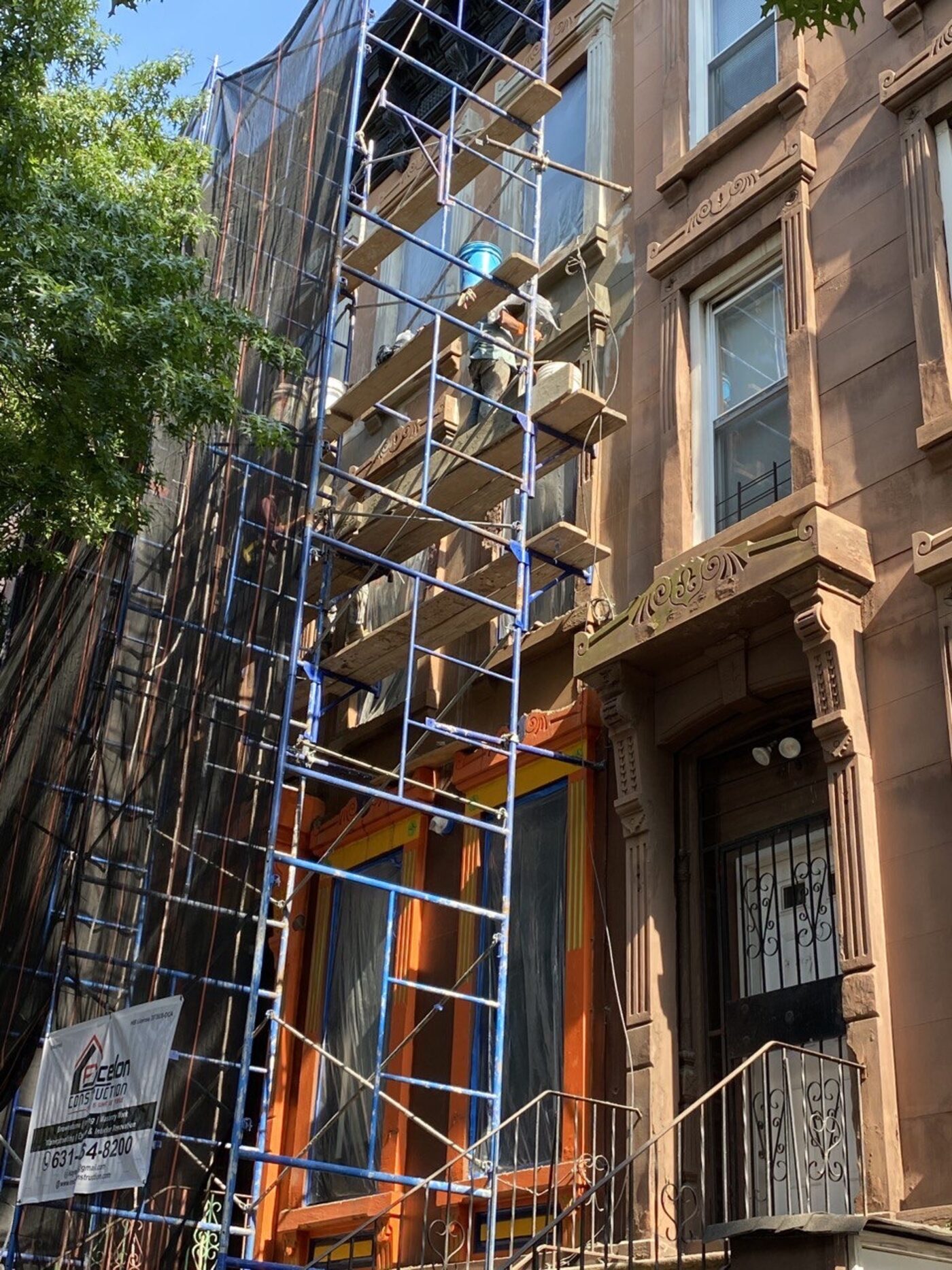
The materials we use — and the ones we will not substitute
Most of what separates a thirty-year restoration from a five-year restoration happens at the material specification level, before any work is done. Here is what we insist on, and why.
Lime mortar over straight Portland on historic brick
Portland-cement mortar is harder than soft historic brick and brownstone. When the wall expands and contracts seasonally, the soft stone gives way before the hard mortar does — meaning your stone breaks, not the mortar joint. Lime mortar (or a lime-Portland blend appropriate to the substrate) is softer, sacrificial, and protects the stone. It costs more. It is not optional.
Vapor-permeable coatings, never sealers
A "sealer" that traps moisture inside the stone is the fastest way to destroy a brownstone facade. We use only vapor-permeable, breathable coatings that allow the stone to release water it has absorbed. There are products that look identical on day one and produce wildly different results by year five — and we know which is which.
Color-matched patches, not paint-over
A restored brownstone should not look like a brown rectangle painted onto a brown building. Color is mixed on-site, often pigment by pigment, to match the existing facade — including its inevitable variation. The hand of the original mason should remain visible.
What we do not use
We do not use silicone-based "miracle" sealers that promise twenty-year waterproofing in a single coat. We do not use proprietary epoxy patching systems that are harder than the surrounding stone and will pop off in three winters. We do not use the cheapest masonry paint we can find at the supply house. We have walked off jobs over this. We will again.
What brownstone restoration costs in NYC
The honest answer is: it depends on what is actually wrong with the building. The slightly less honest but more useful answer is the following ranges, based on twenty years of Excelon estimates on Brooklyn and Manhattan brownstones. These assume a typical four-story row house in average condition — your number could be lower or higher.
Cornice repair & paint
$8K – $25K
Standalone cornice scope. Scrape, prime, seal, color-match, paint.
Stoop restoration
$15K – $45K
Stone re-coating, riser repair, ironwork prep, color-matched finish.
Partial facade restoration
$30K – $80K
Selective spalling repair, repointing, lintel work, lower-facade restoration.
Comprehensive facade restoration
$40K – $200K+
Full facade — stone, brick, cornice, stoop, lintels, waterproofing.
Three things move the number meaningfully: (1) building height — a six-story building is not 50% more expensive than a four-story, it is closer to 100%, because of scaffold, access, and labor scaling; (2) historic district status — LPC review and approved materials add roughly 10–20% to the cost but are not optional; and (3) how long the deterioration has been ignored — a problem caught at year fifteen is meaningfully cheaper than the same problem caught at year thirty.
How long a brownstone restoration takes
Most full-facade restorations on a four-story Brooklyn brownstone run between 6 and 14 weeks, weather-permitting. Smaller scopes run faster:
- Cornice repair only: 3–7 days on site
- Stoop restoration: 2–4 weeks
- Partial facade (lower 2 stories): 4–8 weeks
- Full four-story facade: 6–14 weeks
- Six-story or landmark with permits: 10–20 weeks
We provide a written schedule with every estimate and report progress weekly. Weather is the variable we cannot control — masonry restoration is genuinely seasonal, and any contractor who tells you they can apply lime mortar in 25-degree weather is selling you a problem.
Recent brownstone projects
Every project below is a real address, a real homeowner, and a real piece of work we will walk you to if you want to see it in person.
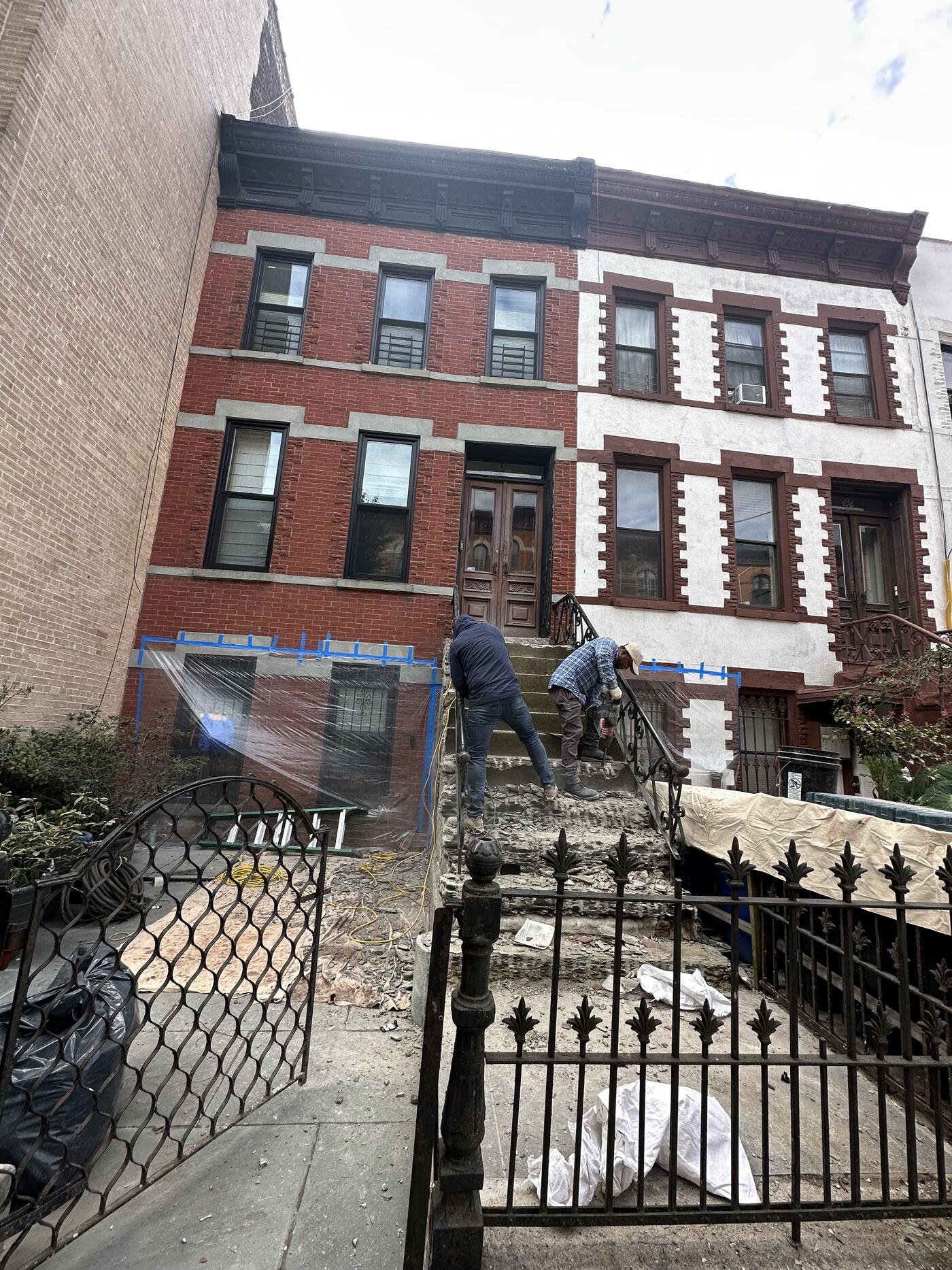
438 15th Street
Full facade brownstone restoration
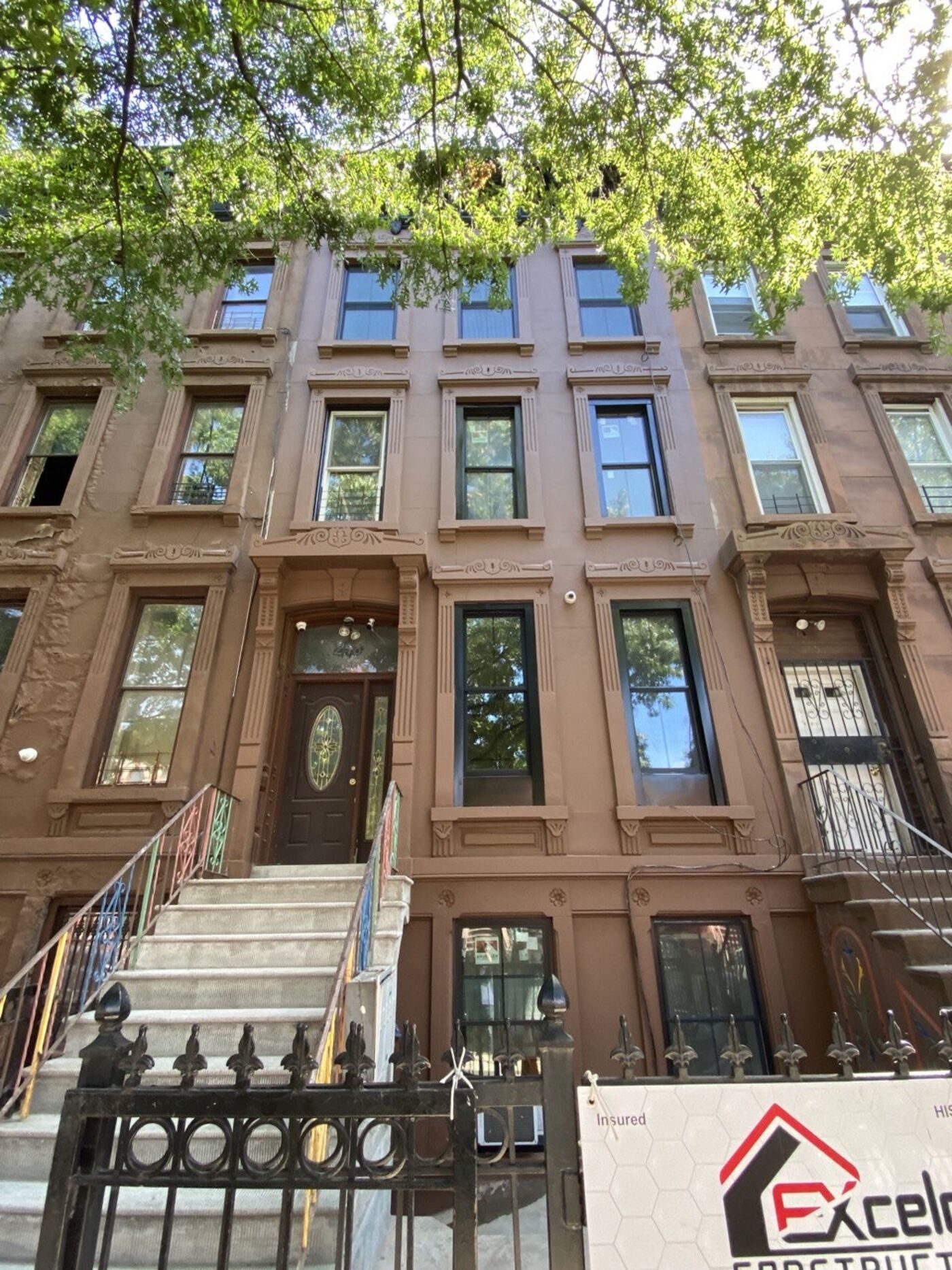
248 Vernon Avenue
Brownstone repair, stoop & cornice
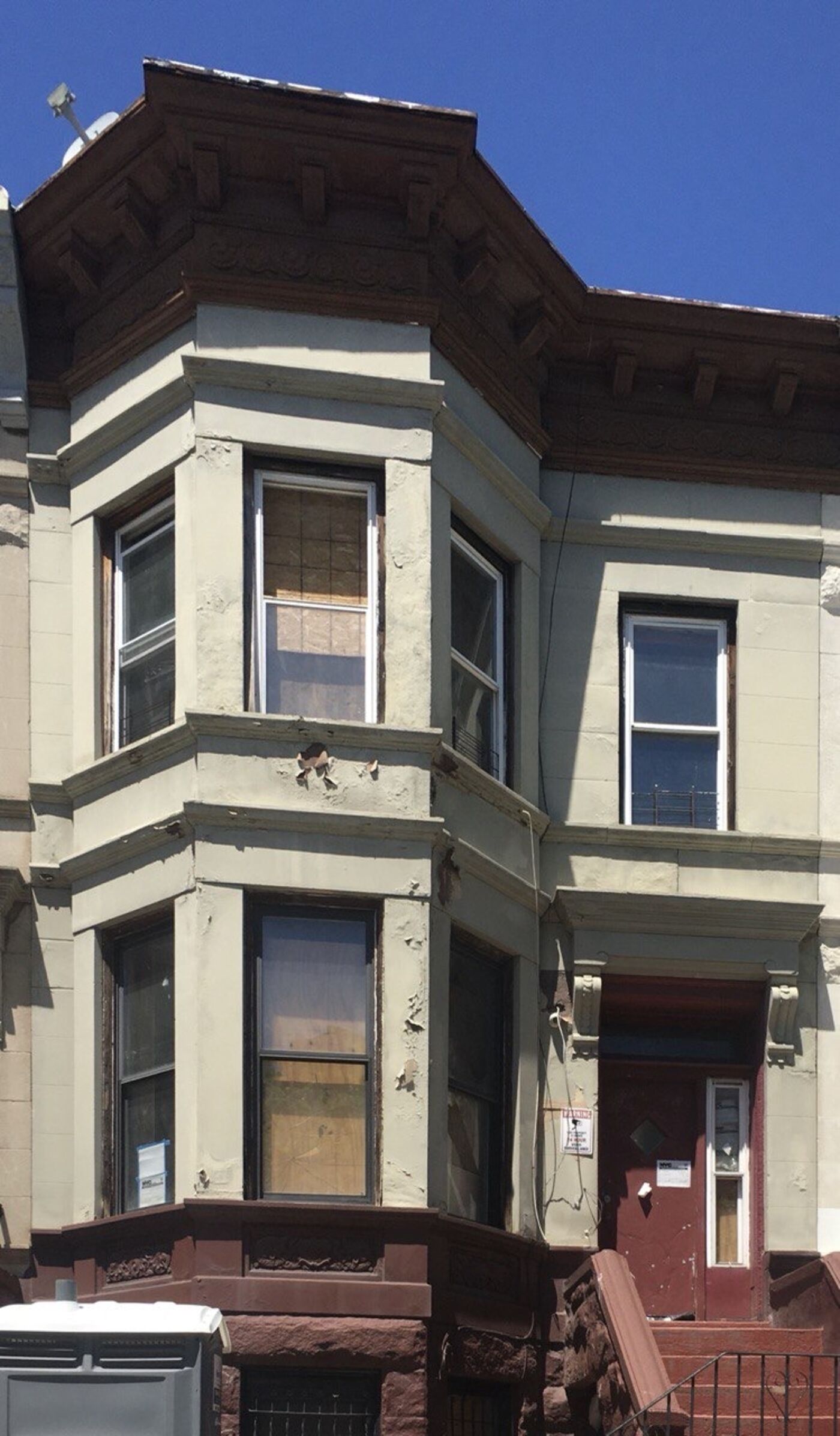
1437 Dean Street
Landmark limestone & painting
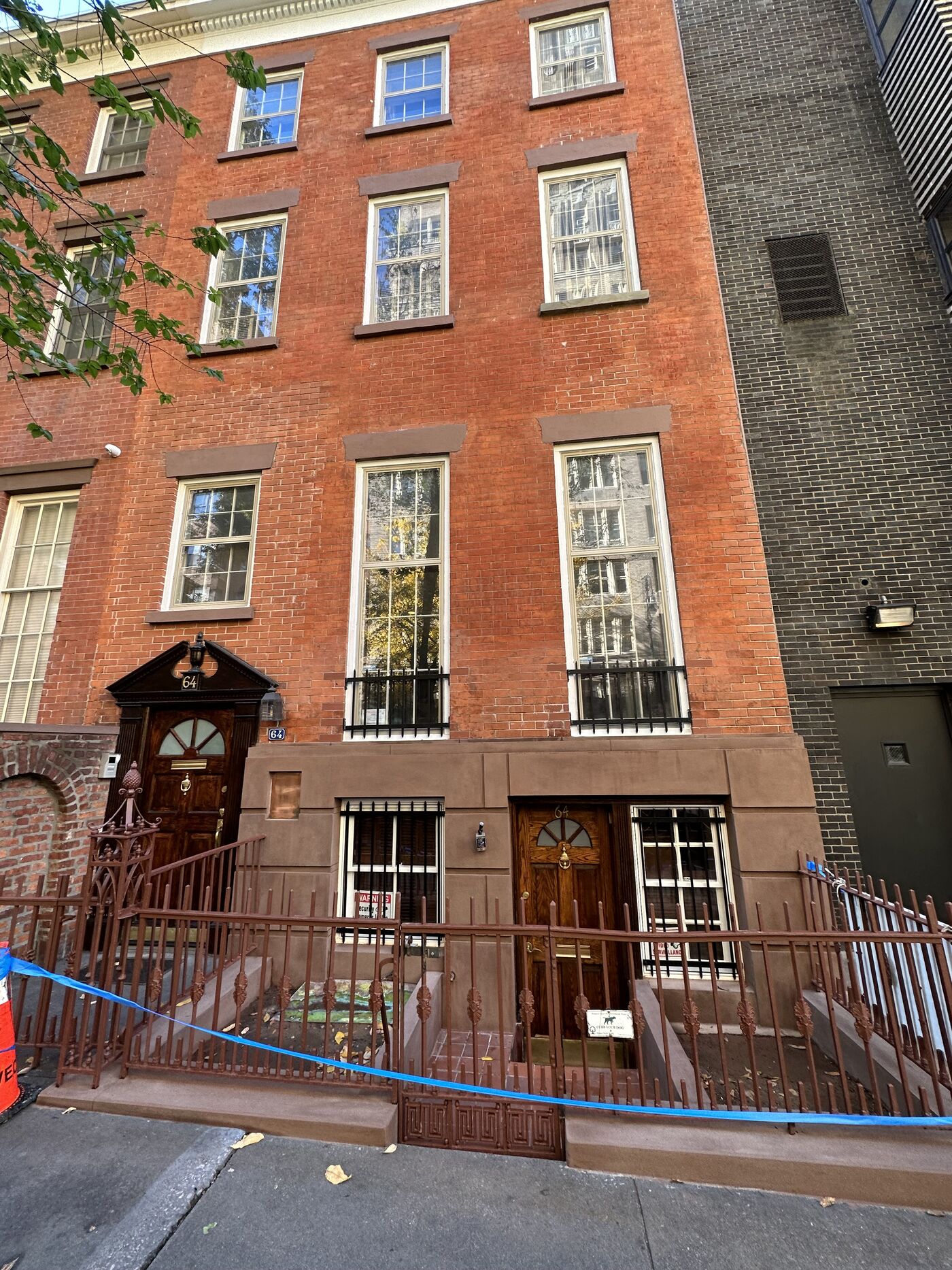
64 West 12th Street
Landmark cornice & brownstone
View all 22+ Excelon projects across Brooklyn and Manhattan →
Frequently asked questions
Will my facade need to be painted again? How often?
A properly restored and coated brownstone facade typically needs no more than light cosmetic touch-up for 15–25 years. The major restoration cycle is roughly every 25–35 years if maintenance (gutter cleaning, basic re-pointing, addressing any new water entry) is kept up. Buildings that have been over-coated with the wrong sealers or painted with non-permeable paint may need work much sooner — sometimes within 5 years.
Do I need permits? What about LPC approval?
For most exterior masonry restoration work in NYC, a DOB permit is required. If your building is in a designated NYC Landmarks Preservation Commission (LPC) historic district — which includes much of Park Slope, Brooklyn Heights, Cobble Hill, Boerum Hill, Fort Greene, parts of Crown Heights, Greenwich Village, and the Upper East Side — you will also need LPC review and approval. We coordinate both processes as part of every project that requires them.
What if I'm just buying the brownstone and want a pre-purchase assessment?
We do paid pre-purchase facade assessments for buyers, typically $400–$800 depending on building size. The deliverable is a written report identifying expected near-term, mid-term, and long-term restoration costs, plus any urgent issues. Many of our long-term clients first met us this way.
My contractor said he can power-wash and paint the facade for $5,000. Is that real?
It is real in the sense that someone will charge you $5,000 to do it. It is not real brownstone restoration, and we will not do it. Power-washing soft historic stone removes original surface and exposes the layered substrate beneath. Painting over unaddressed deterioration traps water and accelerates spalling. The job will look acceptable for 18–36 months and meaningfully worse than the starting condition by year five. We have replaced more than one of these.
Can you handle Local Law 11 / FISP repair work?
Yes. We do not perform the FISP inspection itself (that requires a licensed QEWI architect or engineer), but we are the contractor that performs the resulting masonry repairs to the QEWI's spec — and we work with most major QEWIs in Brooklyn and Manhattan. If you have an "Unsafe" or "SWARMP" filing on your building, call us.
How do I know if my facade needs restoration now or can wait?
Tap test, look up, look down. Tap test: tap the stone surface gently with the handle of a screwdriver — sound stone rings; delaminating stone thuds hollow. Look up: look at the cornice, the lintels above windows, and the parapet above the cornice. These fail first. Look down: look at the stoop and the lower foot of the facade where road salt accumulates. These also fail early. If any of these show flaking, hollow sound, or major cracking, call. If everything looks tight and rings solid, you can probably wait. Sajin will tell you which honestly on a free walkaround.